Wednesday, 19 February 2020

Table tennis
The ease and relative affordability of table tennis has made it one of the most popular sports in the world today in participation. Not only is the game easy to learn, but it is also extremely fun and requires little financial investment or space.
All you need is a table, a net, a ball and a racket to get started. You can play anywhere, at any anytime and just a couple of hours a week hitting that little white ball around can do wonders for your fitness.

Like all sports, there are of course some rules to follow, whether you’re playing a friendly match at the HDB void deck or participating in a tournament. The International Table Tennis Federation (ITTF) is the sport’s main regulatory body and sets the rules for the game.

Your Equipment

While there are fewer restrictions in a friendly match, the ITTF carefully regulates the equipment used during a tournament.

The table, or playing surface, should be 2.74m long and 1.525m wide, on a platform 76cm above the floor. The top of the net, along its whole length, must also be 15.25cm above the playing surface.

In a tournament, the ball used must have a diameter of 40mm and weigh exactly 2.7g. Additionally, the ball can only be made out of celluloid or similar plastics material and be either white or orange, and matt, in colour .

Finally, the racket can be of any size, shape or weight but the blade must be flat and rigid and be made out of 85% natural wood. Before the start of a match, a player must allow his/her opponent and the umpire to inspect the racket he/she is about to use.

Playing The Game

A game is started when one player (server) makes a service before the receiver makes the return.

The Server should:
- start with the ball resting freely on an open palm.
- project the ball near vertically upwards, without imparting spin, so that it rises at least 16cm.
- strike the ball so that it touches first his/her court and then, after passing over the net assembly, touches directly the receiver's court. In doubles, the ball must touch successively the right half court of server and receiver.
Once the ball has been served, both players are to make returns until a point is scored. In doubles, each player on the same team must take turns to make the return.

After 2 points have been scored, the receiving player/pair shall become the serving player/pair and so on until the end of the game.

Field Hockey Rules

Field Hockey
Hockey is a game that is played around the world by many countries. Some of the top hockey playing nations includes India, Pakistan, New Zealand, Netherlands and Great Britain. The pinnacle of the sport comes in the form of the Olympics where it has been one of the top attended sports since its reinstating in 1928.

Object of the Game

The object of hockey is to hit a ball with a stick into a goal. Every time the ball goes into the goal then a point is awarded to that team. The team with the most goals at the end of the game is awarded the winner. In the event of both teams scoring the same amount of goals then a draw is called.

Players & Equipment

Each team consist of 11 players. It’s split up into 1 goalkeeper and 10 outfield players. The outfield players will consist of defenders, midfielders and attackers. The amount of each position will vary deepening on the formation that the team adopts. It’s not massively uncommon for a team to have no goalkeeper at the end of game if they are trying to push for a win or a losing the match.
The pitch is 100 yards long and 60 yards wide. It has three lines running across the width of the pitch which are two 25 yard lines and a half way line to signify to players the certain sections of the pitch. At each end the pitch will include a goal which is 4 yards wide. Around the goal is a 16 yard line which is the only sections on the pitch that players are permitted to shoot from. A goal scored outside the 16 yard line will not be awarded and the ball turned over.
A hard ball is used in hockey along with each player having a wooden stick. Only the flat side of the stick can be sued and a foul will be called for any player using the back. The stick can be turned around in the players to hit the ball both ways. For protection players wear shin pads and gum shields. Goal keepers wear a lot more padding due to ball flying in their direction more often. A face mask, helmet, padded gloves, chest pad and leg guards are all part of the attire for a goalkeeper. Some players do wear eye and face masks as well.

Shot Put Guide

Shot put is a track and field event that requires a great deal of focus, strength, and skill. In order to perform to your greatest ability, it is important to be provided with the right equipment. Sports Unlimited offers quality products that suit all of our athlete?s needs.
How Do You Play Shot Put?
Shot put is a track and field event that involves the throwing of a heavy, spherical object (the shot) as far as possible. Competitors are positioned inside of a 2.135 (7ft.) meter- marked circle with a stop board that is an approximate 10 cm (3.9in) high. Once the toss is complete, the distance is then measured from the inside of the circumference of the circle to the nearest indent made on the ground?s surface, which is typically sand. The distances are then rounded to the nearest centimeter under the rules of both the International Association of Athletics Federation (IAAF) and World Masters Athletics (WMA).
How To "Throw" A Shot Put
It is important to understand that the shot cannot be thrown like a baseball, but rather pushed. *Throwing the shot incorrectly can result in disqualification during competition or more importantly, a serious injury. Before the shot is released, athletes carefully hold it in their hand and rest it on their shoulder. This is followed by a few hops within the circle and a forceful push, letting loose of the shot. The stop board allows the competitor to stop before stepping out of bounds of the circle.
Shot Put Styles
Glide - (1951) Parry O?Brien, a former shot put champion, invented the ?Glide? technique in which the athlete would face backwards and would make a 180? rotation across the circle thus releasing the shot.
Spin - (1972) Aleksandr Baryshnikov, a former shot put champion set his first record through the use of the ?Spin? technique. The term is just as it sounds. Just like discus throwers, this technique allows for the athlete to make a complete spinning rotation providing extra force and momentum, as well as a high rotational speed upon release of the shot.
Shot Put Training Tips
Though most people think that shot put primarily focuses on arm strength, most do not realize that the majority of the force comes from your legs and core. Workouts such as squats, leg lifts, and crunches will strengthen your legs and core, which will allow for a faster rotation upon release of the shot.
Rest is very important in between training sessions because overworking your muscles can result in serious injuries.
Find your rhythm: Before throwing the shot, it is important to have a rhythm down that will be beneficial every time you approach the throw.

Football (Soccer) Rules

Football (Soccer)
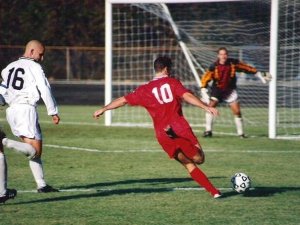
Photo credit: Rick Dikeman (source)
Football (Soccer) is one of the oldest sports in the world and with that; it’s also one of the most recognised. The pinnacle of the international game comes in the form the Football World Cup. There are also tournament such as the Euro Championships, Copa America and the African Cup of Nations. Domestically the strongest leagues come from England (English Premier League), Spain (La Liga), Italy (Serie A) and Germany (Bundesliga). In parts of the world the sport is also known as Soccer.

Object of the Game

The aim of football is to score more goals then your opponent in a 90 minute playing time frame. The match is split up into two halves of 45 minutes. After the first 45 minutes players will take a 15 minute rest period called half time. The second 45 minutes will resume and any time deemed fit to be added on by the referee (injury time) will be accordingly.

Players & Equipment

Each team consists of 11 players. These are made up of one goalkeeper and ten outfield players. The pitch dimensions vary from each ground but are roughly 120 yards long and 75 yards wide. On each pitch you will have a 6 yard box next to the goal mouth, an 18 yard box surrounding the 6 yard box and a centre circle. Each half of the pitch must be a mirror image of the other in terms of dimensions.
Essentially the equipment that is needed for a soccer match is pitch and a football. Additionally players can be found wearing studded football boots, shin pads and matching strips. The goalkeepers will additionally wear padded gloves as they are the only players allowed to handle the ball. Each team will have a designated captain.

Basketball

basketball-goal


The rules of basketball can vary slightly depending on the level of play (for example professional rules differ from college rules) or where the game is played (international rules are different from USA professional rules). These rule differences, however, are usually just variations on the basic game of basketball and the majority of the rules discussed below can be applied to most any game of basketball played.

The winner of a basketball game is the team with the most points. You get points by throwing the basketball through the opponent's hoop or basket. In regular play a basket made from within the three point line is worth 2 points and a basket shot from outside the three point line is worth three points. When shooting a free throw, each free throw is worth 1 point.

Rules for the offense

The basketball team on offense is the team with the basketball. When a player has the basketball there are certain rules they must follow:

1) The player must bounce, or dribble, the ball with one hand while moving both feet. If, at any time, both hands touch the ball or the player stops dribbling, the player must only move one foot. The foot that is stationary is called the pivot foot.

2) The basketball player can only take one turn at dribbling. In other words, once a player has stopped dribbling they cannot start another dribble. A player who starts dribbling again is called for a double-dribbling violation and looses the basketball to the other team. A player can only start another dribble after another player from either team touches or gains control of the basketball. This is usually after a shot or pass.

3) The ball must stay in bounds. If the offensive team looses the ball out of bounds the other team gets control of the basketball.

4) The players hand must be on top of the ball while dribbling. If they touch the bottom of the basketball while dribbling and continue to dribble this is called carrying the ball and the player will lose the ball to the other team.

5) Once the offensive team crosses half court, they may not go back into the backcourt. This is called a backcourt violation. If the defensive team knocks the ball into the backcourt, then the offensive team can recover the ball legally.

Handball Rules

Handball
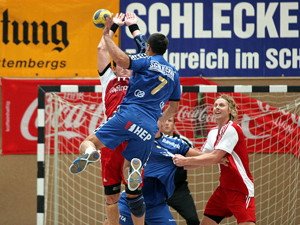
Photo credit: Armin Kübelbeck (Source)
The origins of handball can be traced back to medieval times but it was in 1906 that the rules of modern handball were first created in Denmark. The game is hugely popular in Northern and Eastern Europe but is played around the world.
The governing body of the game is the International Handball Federation, who also organise the World Championships. It is believed that there are around 19 million handball players in the world today.
Handball is traditionally played indoors but there have been variations such as field handball and beach handball (sometimes referred to as sandball) that have been played outdoors.

Object of the Game

The object of handball is to score more points than your opponent.
A handball game lasts for a regulation 60 minutes. This is split into two periods of 30 minutes each with a 15 minute interval. For younger players, the period time can be reduced to 20 minutes.

Players & Equipment

The standard handball games features 7 players on each side, six outfield players and one goalkeeper. A team will also have 7 substitutes, which can be used on a rolling basis and with no need to notify the referee.
There is semi-circle area around each goal area, sometimes referred to as the crease or the zone. There is also a dashed semi-circle line which lies 9 metres from goal, which is the free throw line.
The ball must be made from leather or synthetic material and it must be of a size to fit in the hand of a player. This means that there are three regulation sizes of handball. One for over 8s where the ball has a circumference of 50-52 cm, a II for women and males aged 12 to 16 where the ball has a circumference of 54-56cm and a III for males aged 16 and over, with a circumference of 58-60cm.
A handball game can be played with a court, two goals and a ball. Official games will see teams where uniforms.

Throwball Rules

Throwball
Throwball is an exciting non-contact sport that is played by two teams of seven players on a rectangular court with a net across the middle. The game shares its roots with volleyball and whilst, on the surface, it may look similar, there are some fundamental differences. Like volleyball, it is played on a court that is split into two with a net in the middle but the playing surface of the court is much larger than a regular volleyball court.
The other fundamental difference is that there is no ‘volleying’ in Throwball. As the name would suggest, instead of parrying balls, they are thrown into the opposition area who then must prevent a point being scored by catching it and immediately returning it. It’s a thrilling, dynamic sport that is full of action from the first minute which is why as a sport it continues to grow in popularity around the world.
Throwball is played around the world but it is in the Indian subcontinent that it is most popular and its overseas hubs of popularity tend to be where there are sizeable Indian communities. It is thought to have originated in England, descended from a popular game played by women and then exported to India via the YMCA who brought it to Chennai in the 1940s. The first rules for Throwball were written by Harry Crowe Buck of the YMCA in 1955 and the sport gradually grew in popularity over the next few years, with the Throwball Federation of India being formed in 1985.
Baseball game
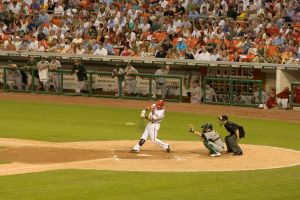
Baseball is often called the "National Pastime" of the United States. A sport that was mostly invented in the United States, baseball is considered a big part of the USA's history and culture. Baseball's influence over pop culture can be seen in its influence in movies, art, television, news, and more over the years.
baseball-batter
Baseball is popular at all levels of age and skill and in many different areas of the world. Often kids grow up playing baseball with many children playing T-ball (a form of baseball where the ball is placed on a Tee so it's easy to hit) at the age of 4 or 5 and then moving on to coach-pitch, player-pitch, little league, high school, college, and the Major Leagues. Professional baseball in the United States has many levels of baseball called the minor leagues. In the minors, players hone their skills and grow into major league players. The minor leagues also gives small towns the opportunity to have their own professional baseball team and have been a big part in keeping baseball popular.

Baseball is a sport that combines many different physical and mental talents. Many players are specialists like the pitcher who specializes in throwing the ball accurately to the hitter, but also making the ball difficult to hit. Some players are good at hitting home runs while others are experts at fielding. It's this combination of skills and team play that make the game complex and interesting.

Baseball is different from many other major sports, like basketball and football, in that there is no clock. This gives baseball a slow, methodic pace that is unique and also is ideal for long, lazy summer days when the game is played. Strategy and subtlety are key elements to winning games.

Baseball also has a rich history of unique players and personalities that have become household names. Some of these players include Babe Ruth, Joe DiMaggio, Hank Aaron, and Jackie Robinson.

Baseball's long history, heroic players, and rich game play have made it one of the world's most popular sports.

Softball Rules

Softball
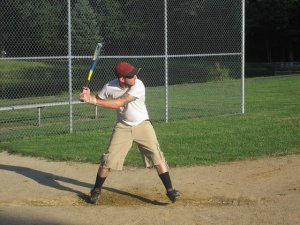
Photo credit: Seth Werkheiser (Source)
Softball is a variation of the sport baseball. It’s more commonly played at a recreational level and played on a pitch smaller than that of baseball. Whilst the rules are very similar there are some that differ. The sport is widely played throughout North America but there are also professional leagues played in Asia, Europe and South America.

Object of the Game

The object of softball is to hit the ball with a bat before the player tries to run around an infield with four bases. Once a player manages to get right round without being given out a run is scored. The team with the most runs at the end of the game is deemed the winner.

Players & Equipment

Each softball team has 9 players. The game takes place over 7 innings and within each innings the team will bat then field. An innings is split into two sections called the top and the bottom of the innings. The away team bats first at the top of the innings whilst the home team field, then teams switch so the home team bats at the bottom of the innings.
Pitch sizes vary in softball and are often just whatever size can be found or used at the time. The in- filed has four bases in a diamond shape. The bases are home base (where the batter stands), first base, second base and third base. Home plate can be found in the centre of the field where the pitcher must stand to throw the ball. The pitcher must throw the ball underarm and must have at least one foot on the plate at the point of delivery.
Once a batting order is set at the start of the game it cannot be changed throughout. A batsman can be given out by being caught by a fielder without the ball bouncing, missing the ball three times in which a strike is called or by being tagged by a fielder holding the ball whilst running between bases. A batsman can be walked to first base if the pitcher fails to get the ball within the strike zone 4 times without a stroke being made. The strike zone in softball is larger than that of baseball.
Teams can be mixed with men and women or with just a single sex on each team. Once a team have completed their innings then the teams switch to do the opposite role. An innings is complete when the fielding team manage to get three players out from the bating team.
Sepal takraw
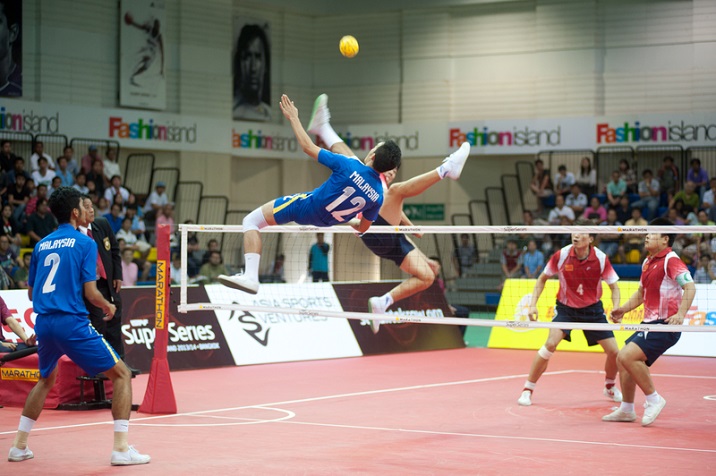
Sepak Takraw is a foot volleyball game where players touch as well as handle the ball using only their feet, knee, chest and head. The rules and regulations of the game are very much similar to that of volleyball. A very popular game around Southeast Asia, the game is played using a rattan or synthetic ball. Since 1990, Sepak takraw is also included in Asian games.
Sepak Takraw
Similar to volleyball, here also two teams of players try to control the ball by touching it using only their feet, chest, knee or head and try to kick the ball past the net to the opposition side. Failing to kicking the ball past the net results in a point to the opposition and the first team scoring the maximum point is declared winner.

Participating Countries

Even though Sepak Takraw is quite popular in Southeast Asian countries, its popularity is also spreading in other parts of the world including European as well as American countries. In Los Angeles, there is already a Sepak Takraw community which is familiarizing the game around the country. In Canada also, the game has experienced widespread popularity.
Some of the countries where Sepak Takraw is quite popular or emerging as one of the popular games are Malaysia, Thailand, Indonesia, Korea, Japan, India, Philippines, Brunei, USA, Pakistan.